
The 3Ps Framework: A New Operating System for RIAs
 Naaz Scheik· May 12, 2026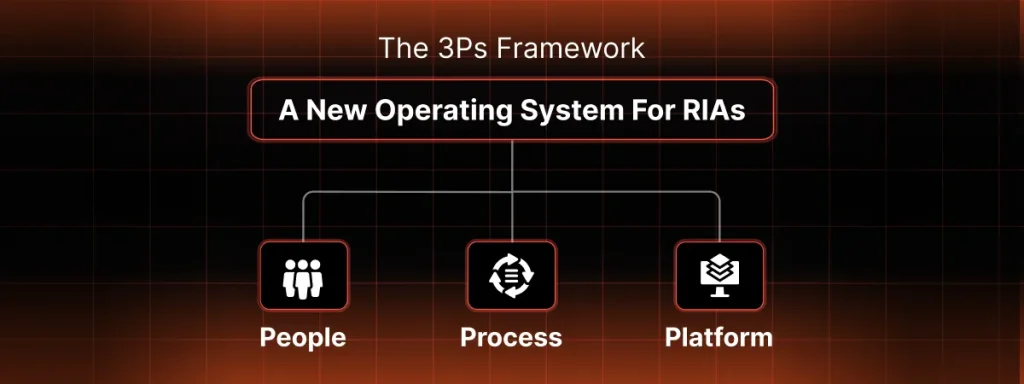
The RIA industry is not struggling to grow. By most measures, it is expanding at a meaningful pace.
Assets under management have increased significantly, revenue continues to rise, and firms are consistently adding new clients. Industry data shows AUM growth of over 16% and revenue growth approaching 17.6% in a single year, reinforcing that demand is not the limiting factor.
And yet, inside many firms, the experience of growth is increasingly difficult. It does not feel like leverage. It feels like accumulation.
Each new client introduces more operational load than expected. Each additional service layer increases coordination requirements. What should feel like scale begins to feel like strain.
This is the contradiction that defines the current phase of the industry. Growth is strong. But the system supporting that growth is not designed for it.
Key Takeaways
|
The Problem Is Not Demand. It Is How Work Moves Through the Firm.
As RIAs scale, the underlying issue becomes less about acquiring clients and more about serving them consistently. The friction is not external. It is internal.
Work becomes fragmented across teams as processes evolves informally rather than intentionally. Technology stacks expand without integration logic. Decisions are made locally, without system-level coordination.
As a result, capacity does not increase in proportion to growth. Firms respond by hiring more staff or layering in more tools. In fact, nearly 83% of firms report hiring as a priority, which reflects how growth is being absorbed through people, not through system design.
But hiring does not solve structural inefficiency. It redistributes it. And technology, when added without alignment, tends to increase complexity rather than reduce it.
Over time, firms reach a point where growth and effort move together. More clients require more people. More accounts require more coordination. More complexity requires more oversight. At that point, the question becomes unavoidable: what is actually scaling?

A Structural Insight: Scale Is an Alignment Problem
Most firms attempt to solve growth challenges by adding capability. More advisors. More operations staff. More systems. More automation.
But scale is not created by addition. It is created by alignment.
Every operating model, regardless of size, resolves into three fundamental components: how people are structured, how work is executed, and where that work is performed. In other words: People, Process, and Platform.
The concept itself is familiar. But in practice, these elements are rarely aligned. People are managed through roles and hiring plans. Processes emerge organically and are often undocumented. Platforms are selected based on features, not on how they integrate into the broader system.
The result is not a lack of capability. It is a lack of coordination. And coordination cost is what ultimately limits scale.

The 3Ps Framework: Designing the Operating System

The 3Ps Framework should not be interpreted as a management philosophy or a conceptual checklist. It is a structural design model. Its purpose is to expose how a firm actually operates beneath the surface, how decisions are made, how work flows, and how outcomes are produced, rather than how the organization is described on paper. Most RIAs appear organized when viewed through org charts, job titles, and technology stacks. But those representations rarely reflect how work truly moves through the system.
At its core, the framework forces a firm to confront three fundamental questions. Who owns the outcome when work is initiated? How does that work move from beginning to completion across teams and functions? And where, in practical terms, does execution actually take place within the system?
These are not abstract questions. They are operational ones. Each question isolates a different layer of the firm’s operating model, and more importantly, reveals where friction accumulates.
The objective is not to optimize each layer independently, but to understand whether they are structurally aligned.
People: Ownership Is the First Constraint
Most RIAs evaluate their growth capacity through the lens of headcount. The focus tends to be on how many clients an advisor can manage or how many accounts an operations team can process.
This framing assumes that capacity is the primary constraint. In practice, it rarely is. The deeper issue is ownership.
In many firms, roles are clearly defined, but accountability is diffuse. Work moves across multiple individuals, but ownership of the final outcome is often unclear.
When a breakdown occurs, whether in client onboarding, rebalancing, reporting, or service delivery, it is not immediately evident who is responsible for resolving it.
This lack of clarity introduces delay. Issues are escalated, handed off, revisited, and often duplicated. The system compensates through effort rather than structure.
As the firm grows, this ambiguity compounds. Additional hires do not resolve the issue. They increase the number of handoffs. More people become involved in each workflow, but without clear ownership, coordination becomes more complex. The system becomes dependent on individual intervention rather than institutional clarity. Work gets done, but not efficiently, and not predictably.
Scaling requires a shift away from participation-based roles toward outcome-based ownership. It is not enough to assign tasks. Ownership must be defined at the level of results. Without that, every incremental client adds not just workload, but coordination overhead. And coordination, not capacity, becomes the limiting factor.
Process: Variability Is the Hidden Cost of Growth
In most RIAs, processes are not designed. They are inherited. They evolve gradually as the firm grows, shaped by immediate needs rather than long-term scalability. At smaller sizes, this is manageable. Flexibility compensates for lack of structure, and informal workflows can still deliver acceptable outcomes.
However, as the firm expands, variability begins to surface. Different advisors develop different ways of managing client relationships. Operations teams adapt processes based on local preferences or constraints. Service delivery becomes inconsistent across the organization. What was once flexibility becomes fragmentation.
This is further intensified by the industry’s emphasis on personalization. Firms aim to differentiate through tailored client experiences, customized portfolios, and individualized service models. While strategically sound, this introduces additional layers of process complexity. Without a structured foundation, customization is not controlled. It spreads across the system, creating exceptions rather than designed variations.
The consequence is reduced predictability. Workflows become harder to track. Outcomes become less consistent. The system requires continuous intervention to maintain quality. Over time, more effort is required simply to preserve baseline performance.
Repeatability, in this context, is often misunderstood. It is not about rigid standardization. It is about establishing a controlled operating environment where variation is deliberate and managed. A scalable process does not eliminate flexibility. It contains it. Without that containment, growth introduces entropy rather than leverage.
Platform: Integration, Not Features, Determines Scale
Technology has become central to how RIAs operate.
Most firms have invested significantly in building out their technology stack, often combining CRM systems, portfolio management platforms, reporting tools, financial planning software, and increasingly, AI-driven capabilities.
On the surface, this suggests a high level of sophistication.
But capability is not the same as coherence.
In many cases, these systems are implemented to solve discrete problems.
Each platform addresses a specific need, client data management, performance reporting, trading, or planning. However, they are rarely designed to function as a unified system.
As a result, data is distributed across multiple environments. Reconciliation becomes a manual exercise. Workflows break as they transition from one system to another.
Teams spend a significant amount of time managing these transitions. They extract data, reformat it, re-enter it, and validate it across platforms. This work is rarely visible, but it is substantial.
It introduces delays, increases the risk of error, and consumes capacity that could otherwise be directed toward higher-value activities.
The issue is not the absence of technology. It is the absence of integration. Most firms optimize for features at the tool level, rather than interaction at the system level. This leads to redundancy, overlap, and fragmentation.
The introduction of AI further highlights this dynamic. While many firms are adopting AI tools to enhance productivity, the impact depends entirely on how those tools are embedded within existing workflows. If AI is layered onto a fragmented system, it does not reduce complexity. It accelerates it.
Technology should reduce coordination cost. In many cases, it increases it. Without structural alignment across the platform layer, systems become an additional source of friction rather than a source of scale.
Where the Model Breaks: At the Intersections
Operating models rarely fail because one component is weak. They fail because the components do not align.
When people are added without defined processes, firms become dependent on individuals. When processes exist without supporting platforms, work becomes manual and inefficient. When platforms are implemented without structural alignment, tool sprawl emerges.
Most firms attempt to solve these issues incrementally. They hire. They document workflows. They add systems. But the system does not stabilize, because the problem is not isolated. It is structural.
The breakdown occurs at the intersections, where people, process, and platform are expected to work together, but do not.
The Mid-Scale Inflection Point

The consequences of misalignment become most visible at the mid-scale stage, typically between $100M and $500M in AUM. At this point, the firm has outgrown the operating model that initially supported its growth.
What was once manageable through informal coordination and individual effort begins to strain under increased complexity. Teams start to specialize, service offerings expand, and the technology stack evolves, often reactively, into a collection of loosely connected systems. The structure that worked at $50M begins to break at $250M, not because the firm is doing something wrong, but because the system was never designed for this level of scale.
The impact is operational, not theoretical. Advisors find themselves spending more time coordinating across teams than engaging with clients. Operations teams shift from executing workflows to reconciling inconsistencies across systems and processes. Work still gets done, but it requires more effort, more communication, and more intervention. Growth continues, but efficiency declines. This is not a transitional phase that resolves with time or incremental fixes. It is a structural signal. The operating model has reached the limits of its design, and without intentional realignment, additional growth will only increase the strain.
Why Implementation Is Difficult
The difficulty of the 3Ps Framework is not conceptual, it is structural. Most firms understand the logic of aligning people, process, and platform, but applying it requires redesigning how the organization actually operates.
This means redefining ownership across teams, introducing process discipline without eliminating necessary flexibility, and rationalizing technology without disrupting day-to-day execution.
More fundamentally, it requires a shift in perspective, from focusing on how to accelerate growth to examining how the system absorbs and sustains it. Many firms never make this shift. They continue to add layers, more hires, more tools, more process adjustments, without addressing the underlying design.
Over time, this accumulation increases coordination cost, and the system becomes heavier rather than more scalable.
A Different Starting Point
If growth in your firm feels heavier than it should, the answer is not to hire faster or add more tools. Both are reactive responses. They increase activity, but they rarely improve how the system functions. The more effective starting point is to examine the structure itself, where ownership breaks down, where process introduces unnecessary variability, and where technology creates friction instead of flow.
These are not tactical questions. They are structural ones. Sustainable scale is not created by adding capacity. It is created by aligning how that capacity operates within the system.

Rethink How Your Firm Scales
If you are planning the next phase of growth for your firm, begin by evaluating your operating system, not your pipeline. Growth rarely fails at acquisition; it breaks down inside the system. And ultimately, it is alignment, not activity, that determines whether that system can hold.
Other Relevant Reads: