


You might hear the phrase “rollover IRA” while you’re quitting your job. However, what are IRA rollover benefits exactly? When an employee leaves their employer-sponsored 401(k) plan, they can choose to transfer their retirement funds to an individual retirement account (IRA) at another financial institution. They move their 401(k) funds to this IRA, which is known as a rollover IRA. You should probably start a standard IRA if the 401(k) plan wasn’t a Roth 401(k).
A rollover IRA is a typical IRA in this case as well. They aren’t always the same, though. A conventional IRA does not have to be a rollover IRA. Continue reading to learn important distinctions between a traditional IRA vs rollover IRA.
| Key Takeaways
|
Key Points
- When someone leaves their work, they often roll over their money from a qualifying retirement plan, such as a 401(k), into an individual retirement account (IRA).
- The account holder makes direct contributions to a conventional IRA, which are subject to eligibility restrictions and tax deductible up to a ceiling.
- Commingling funds is the process of directing rollover money from an employer-sponsored plan to traditional IRA rollover rules that contains your direct contributions. You might not want to do this, particularly if you intend to move the rollover money to a plan offered by a new employer.
- With the exception of some qualified costs, withdrawals from any kind of IRA made before the age of 59.5 are subject to both income taxes and an early withdrawal penalty.
- At age 73 (for those born in 1951 or after), the IRS mandates that owners of both kinds of IRAs begin taking withdrawals, generally known as required minimum distributions (RMDs).
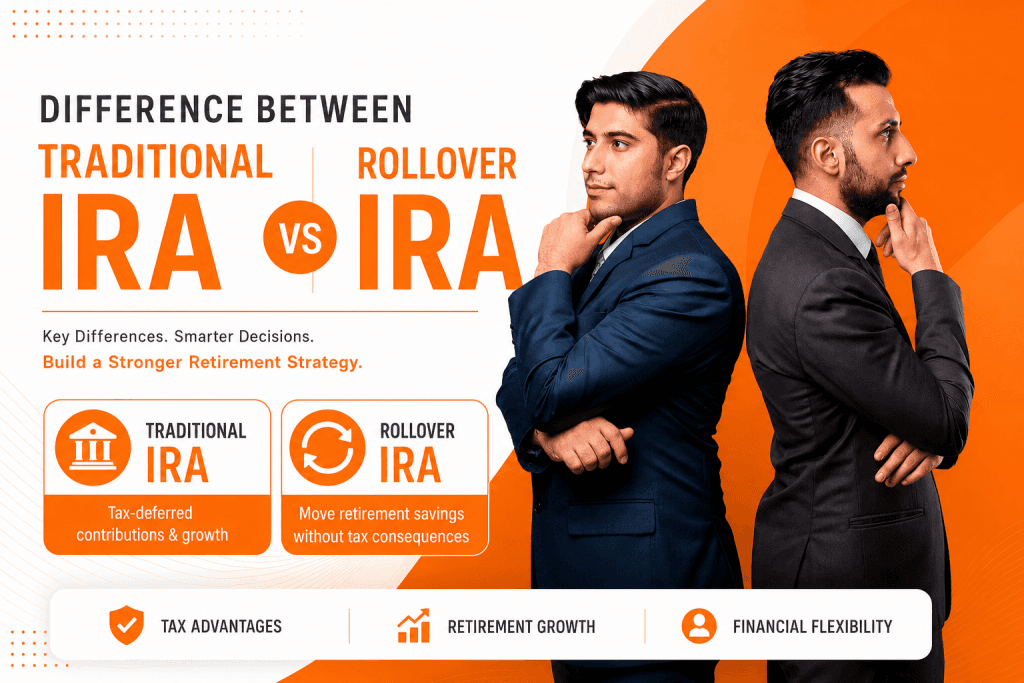
What is the Difference Between a Traditional IRA vs Rollover IRA?
The only significant distinction between choosing between traditional and rollover IRA is that the former’s funds were transferred from an employer-sponsored retirement plan. Other than that, the accounts are subject to the same tax regulations regarding conversions to Roth IRAs, mandatory minimum distributions, and withdrawals.

What Are IRA Rollover Benefits?
An individual retirement account established with funds being rolled over from a qualified retirement plan is known as Rollover IRA for retirement. Generally, rollover IRAs happen when someone leaves a job with an employer-sponsored plan, such as a 401(k) or 403(b), and they roll the assets from that plan into a retirement plan with IRA accounts.
Your funds in a rollover IRA grow tax-free until you take them out in retirement, just like in a regular IRA. When transferring your employer-sponsored retirement plan to an IRA rather than a 401(k) with a new job, there are many benefits:
- Compared to 401(k) providers, IRAs might have reduced fees.
- Compared to an employer-sponsored retirement plan, an IRA might provide a wider range of investing possibilities.
- To make managing your investments easier, you might be able to combine multiple retirement accounts into a single rollover IRA.
- IRAs allow you to take early withdrawals for specific qualified costs, such your first home purchase or college tuition. In these situations, you won’t be subject to an early withdrawal penalty even if you will be paying income taxes on the money you take out.
- Additionally, there are a few rollover IRA regulations that could seem like drawbacks to investing in an IRA rather than keeping your money in an employer-sponsored plan.
- You are unable to take out a loan from traditional retirement savings options for IRA, but you are able to take out a loan from your 401(k) and repay it over time.
- You might not be able to make some of the investments that were available in your 401(k) plan in your IRA account.
- Rolling over firm stock may result in adverse tax consequences.
- Even if you are still employed, you must begin taking Required Minimum Distributions (RMDs) from your IRA at age 73. However, you might be able to postpone your RMDs from an employer-sponsored account while you are still employed.
- The money in an employer plan is protected from creditors and judgments, whereas the money in an IRA may not be, depending on your state.
What Is a Traditional IRA?
You should now become comfortable with traditional IRA rollover rules as we have explained, “What is a rollover IRA?” It helps to know some IRA fundamentals in order to choose between traditional and rollover IRA.
Your investments will grow tax-free until you take withdrawals in retirement because your contributions to a traditional IRA are often tax deductible from the time you create the account.
Some retirees benefit from this since they may find themselves in a lower income tax bracket after retirement than they were when they were working. As a result, they will pay less in taxes on the money they remove than they would have when they made the contribution.
A Side-by-Side Comparison of Rollover IRA vs Traditional IRA
| Rollover IRA | Traditional IRA | |
| Source of contributions | Created by “rolling over” funds from another account, usually a 403(b) or 401(k) provided by the employer. There are no annual contribution caps on the rollover amount. | Although rolled-over funds can also be contributed to traditional IRA rollover rules, this type of account is created by consistent donations that do not exceed the annual contribution cap. |
| Contribution limits | The amount of money you can roll over from another account has no upper limit. The ceiling for contributions made outside of a rollover is $6,500 for the 2023 tax year, with an extra $1,000 if you’re 50 years of age or older. | Up to $6,500 for the 2023 tax year, plus an extra $1,000 if you’re 50 years of age or older. |
| Withdrawal rules | With some exceptions, such as for the purchase of a first home or higher education costs, withdrawals made before the age of 59½ are subject to both income taxes and an early withdrawal penalty. | Income taxes and an early withdrawal penalty apply to withdrawals made before the age of 59½, with few exceptions, such as when funding a first home or paying for further education. |
| Required minimum distributions (RMDs) | After you turn 73, you must take out a specific amount of money from this account year (due to the SECURE 2.0 Act of 2022). | Once you are 73, you must take out a specific amount of money annually from this account (again, according to the SECURE 2.0 Act). |
| Taxes | All withdrawals from this account in retirement will be subject to regular income tax rates because the contributions come from a pre-tax account. | All withdrawals from this account in retirement will be subject to ordinary income tax rates if contributions are tax deductible. (If your contributions were not deductible, you will only be taxed on your retirement income.) |
| Convertible to a Roth IRA | Yes | Yes |
Can You Contribute to a Rollover IRA For Retirement?
You’re undoubtedly asking yourself by now if you can make contributions to a rollover IRA for retirement, and the answer is yes. Contributions to a rollover IRA are permitted up to the IRA contribution restrictions. Individuals may contribute up to $6,500 for the 2023 tax year (plus an extra $1,000 for a catch-up contribution if you’re 50 or older). However, you might not be able to transfer funds from your rollover IRA to another employer’s retirement plan in the future if you do so.
Can You Combine a Traditional IRA With a Rollover IRA?

In essence, traditional IRA vs rollover IRA was established when funds were transferred into it. As a result, you can roll over funds from one IRA to the other or make a direct transfer from one account to the other to merge two IRAs.
Being timely with any transfers is a crucial step in the transfer or rollover procedure that will assist keep the funds from being counted as an early withdrawal or distribution to you. You usually have sixty days to transfer funds from the now-closed fund to the new one when you do an indirect rollover.
Other important things to keep in mind: As previously stated, you might not be able to roll over funds into a future employer’s retirement plan if you add non-rollover funds to a rollover account. Additionally, remember that you can only roll over one IRA to another during a 12-month period. Rollovers from a retirement plan to an IRA are not subject to this limit; it is only an IRA-to-IRA cap.
Conclusion
There is minimal difference between a traditional IRA vs rollover IRA, both of which enable investors to save for retirement in a tax-advantaged manner.
Will you continue to make contributions to your rollover IRA? This is one of the main issues anyone thinking about should ask. If so, you would not be able to later roll over the rollover IRA into an employer-sponsored retirement plan.
Traditional IRA rollover rules that are built with monthly contributions or a rollover IRA that you created by rolling over an employer-sponsored retirement account can both be important components of your retirement strategy.