
The Shrinking Referral Pool: How Custodians Raising Minimum Is Reshaping the RIA Growth Playbook

For years, independent Registered Investment Advisors (RIAs) have grown steadily with help from custodial referral programs.
These programs brought a regular stream of clients without the need for big marketing budgets or complicated client acquisition efforts. But things are changing.
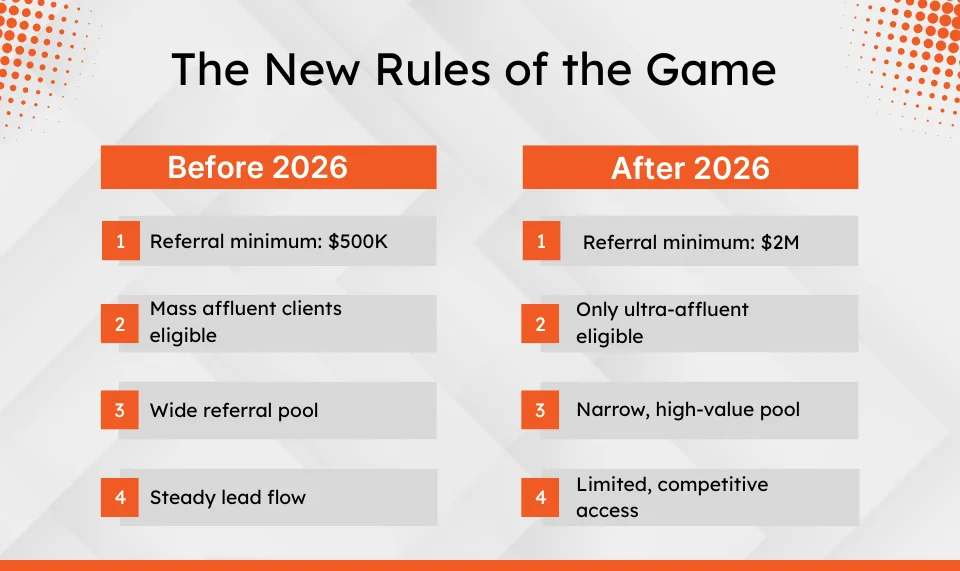
Recently, one of the biggest custodians has announced a significant update to their referral program: starting in 2026, only clients with at least $2 million in assets will be eligible for referral to participating RIAs. That’s a 300% increase from the previous minimum of $500,000.
This $2 million referral minimum doesn’t just tweak a policy; in fact, it reshapes how independent advisors find and grow their client base. The new minimum has sent ripples through the advisory community, signaling a new era in which referrals alone can’t fuel RIA growth.
Let’s find out what this change actually means, why custodians are moving in that direction, and how RIAs can adapt and thrive in this new environment.
Key Takeaways
|
Understanding Rising Referral Minimums
The rising referral minimums trend is a move rooted in strategy. Large custodians for RIAs often double as retail wealth management platforms. This dual role has created a challenge for years.
The question is whether custodians should send valuable clients to independent advisors or keep them within their own services.
By raising referral minimums, major custodians are drawing a clear boundary. Mass affluent clients are increasingly being retained for their own wealth management services, while only ultra-affluent clients, those with more than $2 million, will be eligible for external referrals.
Only ultra-affluent clients, those above $2 million, will be eligible for external referrals.
This shifting trend isn’t arbitrary.
Custodian-owned internal advisory services earn the highest percentage fees on clients with lower balances. For example, clients with up to $1 million pay around 0.80% annually, while larger accounts pay less as balances rise.
By retaining mass affluent clients, custodians maximize profitability. In other words, custodians moving forward are likely to keep their most lucrative client segment close.
What This Means for RIAs
For many RIAs, referral programs have been a dependable growth engine. Some firms relied on referrals for the majority of their new clients. The new policy trend dramatically reduces this source of leads.
By eliminating clients with under $2 million, one of the biggest custodians is effectively cutting at least half of the potential referral volume, with a high likelihood of others following suit, very soon.
That’s a big hit for smaller and mid-sized RIAs that serve mass affluent households, the very demographic now being absorbed by internal advisors.
Tim Welsh, a former Schwab executive, called it a “category killer” for firms built on advisory referrals. Without that steady flow, RIAs will have to replace lost opportunities with their own marketing, networking, and client acquisition strategies.
In short, passive growth is over. The next phase for RIAs will depend on active, independent, and digitally driven RIA growth strategies.
Why This Move Makes Business Sense
From a business perspective, this decision aligns with broader trends among major custodians.
Some custodians that connect clients with third-party RIAs require participating firms to manage at least $500 million in assets and maintain a minimum of $350 million throughout their participation. These custodians focus internally on their most profitable client segments, sending only complex, ultra-high-net-worth (UHNW) cases to external RIAs.
In this new setup, custodians have become competitors. They retain the mass affluent clients, who often produce the highest advisory fees, and refer to the fewer, but more complex, cases that demand specialized expertise.
For major custodians, this strategy enhances internal growth, maximizes margins, and simplifies operations. But for independent advisors, it marks the beginning of a major transformation.

The Ripple Effect: A Two-Tiered RIA Market
The new referral policy deepens the divide between large, established RIAs and smaller, emerging firms. Even before the rule change, referral program participation was exclusive.
Firms needed at least $250 million in assets under management (AUM) and five years of experience to even qualify.
With the new client threshold, the program now caters mainly to large, specialized firms already serving ultra-wealthy clients.
This exclusion disproportionately affects smaller RIAs.
These firms may not meet the asset requirements or may lack the capital to replace referrals with expensive marketing campaigns. As a result, the referral pool is shrinking, and the competition is intensifying.
Competing Without Custodian Crutches
The message for independent RIAs is clear: it’s time to take ownership of client acquisition.
As custodians reshape their referral programs, advisors can not depend on passive referrals anymore for growth.
They need to focus on building their own client base. For that, they require a strong online presence, marketing, and specialized services. Here’s how they can do that.
A. Build a Strong Digital Presence
In today’s wealth management world, clients don’t just take referrals at face value; they research. A referred client will almost always Google the advisor, check their website, and read reviews before reaching out. It means that your online presence should be powerful, evident, and believable.
- Make your site streamlined, communicate a clear message, and optimize service pages and content for search engines.
- Produce educational blogs and guides that display skills in complex financial issues such as estate planning, equity compensation, or tax planning.
- Video marketing helps explain complex strategies in simple terms and reach potential clients on platforms such as LinkedIn and YouTube.
In this digital-first world, content is no longer incidental; it forms the basis of credibility and presence.
B. Specialize to Stand Out
The new structure is designed for rich clients who need advanced planning. RIAs need to develop specialized expertise to compete in this space. This is the only way that can make them stand out.
Firms focusing on niche areas such as cross-border wealth management, business succession, or advanced tax strategies will have an edge over others.
Specialization makes it easier to justify higher fees and helps RIAs attract clients who are actively seeking that level of service. Your specialization should be evident in your content, client stories, and even your digital branding.
Rethinking Growth Economics: From Referrals to ROI
For years, custodial referrals seemed “free.” But in reality, they came with a perpetual cost, basis point fees that continued for as long as the client relationship lasted.
By shifting to self-directed marketing, RIAs face a higher upfront Client Acquisition Cost (CAC) but eliminate the long-term “referral tax.” Over time, this improves profitability.
Consider it moving from renting to owning it.
Research shows that a client relationship can generate between $100,000 and $150,000 in revenue over its lifetime. Even if it costs $5,000 to acquire a new client through marketing, that’s a solid return on investment when viewed long-term.
RIAs that adopt this mindset will be better positioned to scale sustainably.
Comparing Costs: Custodial vs. Organic Acquisition
Channel | Cost Structure | Long-Term Profitability | Control |
Custodial Referral | Ongoing fee per client (basis points) | Moderate | Low |
Digital Marketing | One-time or campaign-based | High | Full |
Content and PR | Initial setup + maintenance | High | Full |
Paid Ads | Variable | Moderate | Medium |
This comparison highlights a key insight: while digital acquisition may seem expensive initially, it builds brand equity and full ownership over the client relationship, two things referrals can never offer.
Technology to Scale Operations and Build Relationships
Technology will become an even more essential driver of scalability for RIA firms. Since HNW and UHNW clients require a different level of service, RIAs must adapt their capabilities accordingly.
This means using technology to automate operations such as rebalancing, reporting, and managing operations.
Adopting financial technology that helps you move faster and address complex client needs will be essential to positioning yourself as a market leader.
Here’s the tech-first food for thought:
Every RIA does rebalancing – but how do you do it better?
- Do you provide householding within your system?
- How tax-efficient is your rebalancing?
- Can you utilize nested models to improve your client’s ROI?
- Are legacy systems and custodial tools good enough for these accounts?
- Are you able to efficiently work across several custodians using your current technology stack?
These are only some of the questions RIAs have to ask themselves, as they compete against each other within the HNW/UHNW clients market.
Technically strong RIAs will use this to their advantage, enabling them to create specialized value propositions for these clients and scale faster than their peers.
The smart use of technology accomplishes one critical thing: it frees up operational time, allowing you to focus on building relationships instead of building reports.
For HNW and UHNW clients, this becomes a key differentiator—one that RIAs must prioritize to continue growing.

Turning Change into Opportunity
In simple words, the changing threshold is not just a policy; it’s a wake-up call. The custodial landscape is evolving, and the firms that succeed will be those that evolve with it. Instead of viewing this as a setback, independent advisors can see it as an opportunity to become more resilient, independent, and client-centered.
The best RIAs will use this moment to:
- Strengthen their brand and digital presence.
- Redefine their niche and service model.
- Build scalable acquisition strategies that stand on their own.
- Utilize technology to become more competitive and truly stand out.
From this perspective, the trend marks not just the end of an era, but the beginning of a new one.
Wrapping Up
The independent advisory space has always been about adaptability and trust.
The future belongs to advisors who take control, those who build their own client pipelines, embrace digital transformation, and specialize deeply enough to compete for ultra-wealthy clients.
The referral pool may be shrinking, but opportunity isn’t. The firms that act now will lead the next generation of independent wealth management.
Other Relevant Reads: